
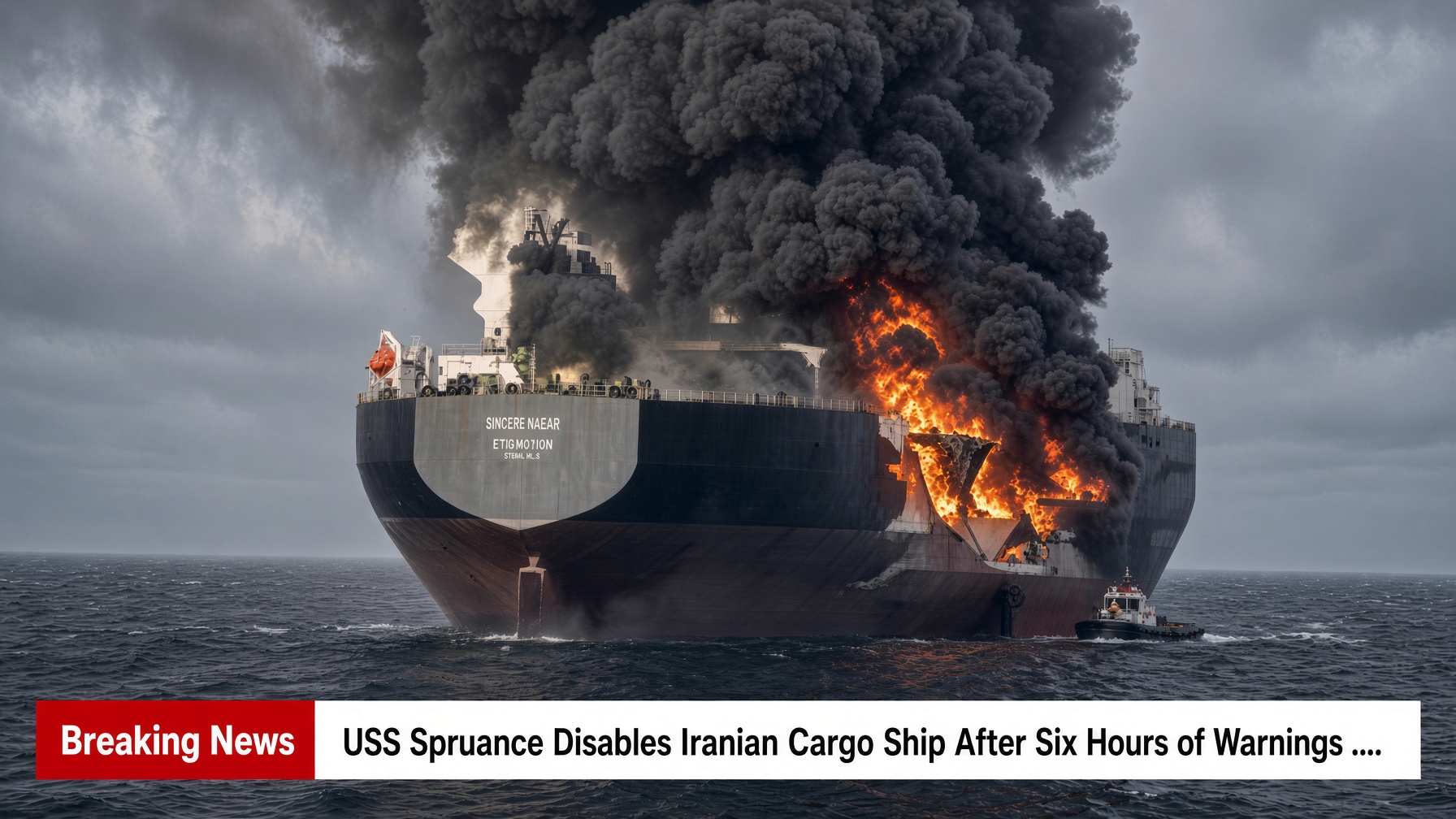
WASHINGTON — A U.S. Navy guided-missile destroyer disabled an Iranian-flagged cargo ship in April after the vessel failed to comply with repeated warnings during enforcement of the U.S. naval blockade of Iranian ports, according to U.S. Central Command.
The incident involved the USS Spruance, an Arleigh Burke-class guided-missile destroyer, and the Iranian-flagged M/V Touska. According to CENTCOM, the vessel was traveling through the north Arabian Sea at approximately 17 knots while heading toward the Iranian port of Bandar Abbas on April 19, 2026.
American forces said the Touska had been warned multiple times that its voyage violated the U.S. blockade. The warnings continued for approximately six hours, but the vessel’s crew did not comply.
Destroyer Uses 5-Inch Gun to Disable Vessel
After the repeated warnings failed to change the ship’s course, the Spruance ordered the crew to evacuate the engine room.
The destroyer then fired several rounds from its 5-inch MK 45 naval gun into the Touska’s engine room, disabling the vessel’s propulsion system and preventing it from continuing toward the Iranian port.
CENTCOM described the operation as a deliberate enforcement action and said U.S. forces took measures intended to compel compliance with the blockade.
The confrontation was captured in military footage released by U.S. Central Command, showing the Spruance operating near the cargo vessel during the operation. U.S. Marines subsequently boarded the disabled ship.
Marines Take Control
Marines from the 31st Marine Expeditionary Unit boarded the Touska after its propulsion had been disabled. The vessel was placed under U.S. custody, according to CENTCOM.
The military said the operation followed a broader effort to enforce restrictions on commercial vessels attempting to reach Iranian ports. At the time of the incident, CENTCOM said U.S. forces had already directed 25 commercial vessels to turn around or return toward Iranian ports since the blockade began.
The Touska was also subject to U.S. sanctions, according to military and maritime reporting. The vessel is associated with Iran’s Islamic Republic of Iran Shipping Lines, which has been sanctioned by Washington.
The operation came amid a broader confrontation involving the United States and Iran, with the Strait of Hormuz and surrounding waterways remaining strategically important for international shipping and energy supplies.
A High-Stakes Maritime Confrontation
The seizure demonstrated how the U.S. blockade was being enforced at sea, with American forces using escalating measures after warnings were unsuccessful.
The incident also carried broader significance because the Touska was a commercial cargo vessel rather than an Iranian military ship. The decision to disable the vessel and board it therefore represented a direct maritime enforcement action during an already tense period in the region.
Iran subsequently condemned the U.S. action, while American officials maintained that the vessel had violated the blockade and failed to comply with repeated orders.
The episode underscored the increasingly high-stakes nature of maritime operations around Iran. With commercial shipping routes facing restrictions and military forces operating in the region, encounters between U.S. forces and vessels attempting to reach Iranian ports remained closely watched.
For the U.S. Navy, the Touska operation became a prominent example of how Washington sought to enforce its blockade: repeated warnings first, followed by disabling action when the vessel did not comply, and ultimately the boarding and seizure of the ship.