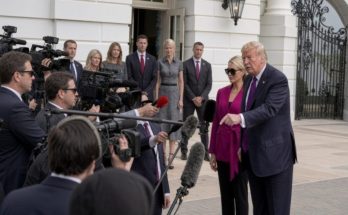
BREAKING NEWS: Reports and social-media claims about an alleged recent fall involving President Donald Trump have renewed public attention on presidential health, medical transparency and the challenges of determining what actually happened from short videos and photographs.
However, the available evidence does not establish that Trump recently suffered a confirmed fall as described in some online posts. A recent fact-check found that several viral claims portraying Trump as having fallen again were based on misleading or AI-generated material. The review noted that Trump has had documented moments of stumbling or gait difficulty, but that those incidents should not automatically be characterized as a confirmed fall.
That distinction is significant because isolated images can quickly circulate without the surrounding context needed to determine what occurred. Presidential health has historically attracted intense scrutiny, particularly when an aging president appears unsteady, stumbles or has difficulty navigating stairs or other surfaces. Trump, who is 79, has faced similar attention during both his current and previous time in office.
Presidential Health and Public Scrutiny
Images and videos of his movements have periodically prompted questions online, while supporters and administration officials have generally pointed to his demanding public schedule and continued appearances as evidence of his activity. But neither photographs nor short video clips can establish a medical diagnosis. A stumble can have many possible explanations, including an uneven surface, footwear, fatigue or an ordinary loss of balance.
Determining whether an incident is connected to an underlying medical condition requires a clinical evaluation and appropriate medical information. That is why distinguishing between a verified event and an online interpretation is particularly important when discussing the health of a sitting president. The White House has provided some formal information about Trump’s health.
On May 26, 2026, Trump underwent his annual medical examination at Walter Reed National Military Medical Center. A memorandum released by the White House physician, Navy Capt. Sean P. Barbabella, said the examination included laboratory testing, diagnostic studies and consultations with 22 specialty providers. The memo concluded that Trump was in “excellent health” and “fully fit” to perform his presidential duties.
Medical Examination Results and Ongoing Questions
The report listed Trump at 75 inches tall and 238 pounds, with a resting heart rate of 73 beats per minute. The administration authorized the release of the findings. At the same time, news organizations have reported that questions remained about certain aspects of Trump’s health that were not fully addressed by the public medical summary.
Axios noted that the report did not resolve questions raised by observers about bruising on Trump’s hands, swollen ankles and some instances in which he appeared to be less alert during public events. Those observations, however, are not themselves medical diagnoses. The debate over presidential health involves two competing public interests.
The public has a legitimate interest in knowing whether a president can carry out the responsibilities of the office. At the same time, medical information is generally private, and presidents retain personal privacy interests regarding their medical records. The result is an ongoing question about how much information should be released when a president experiences an apparent health-related incident.
Transparency, Privacy and Public Discourse
For the White House, detailed medical disclosures can provide reassurance and context. Limited information, however, can leave room for speculation, particularly when photographs or videos spread rapidly across social-media platforms. The latest discussion demonstrates how quickly an unverified claim can become part of a broader political narrative.
A photograph may show a moment of apparent instability without explaining what happened immediately before or afterward. A short video may omit important context. Digitally manipulated or AI-generated footage can make the situation even more difficult for viewers to evaluate.
For that reason, claims about a president’s health are best assessed through official statements, complete video footage, medical reports and reporting from established news organizations rather than isolated social-media posts. The available evidence currently does not establish that Trump suffered a new serious medical event or that an alleged recent fall indicates an underlying health condition.
As Trump continues his presidential schedule, questions about his physical condition and the transparency of medical information are likely to remain part of public discussion. But determining whether a particular incident occurred-and what, if anything, it means medically-requires evidence beyond a viral clip or photograph. For now, the documented record includes previous instances of stumbling or apparent gait difficulty, as well as a comprehensive medical examination released by the White House in May. Claims of a new fall should be treated separately unless and until they are supported by reliable evidence.