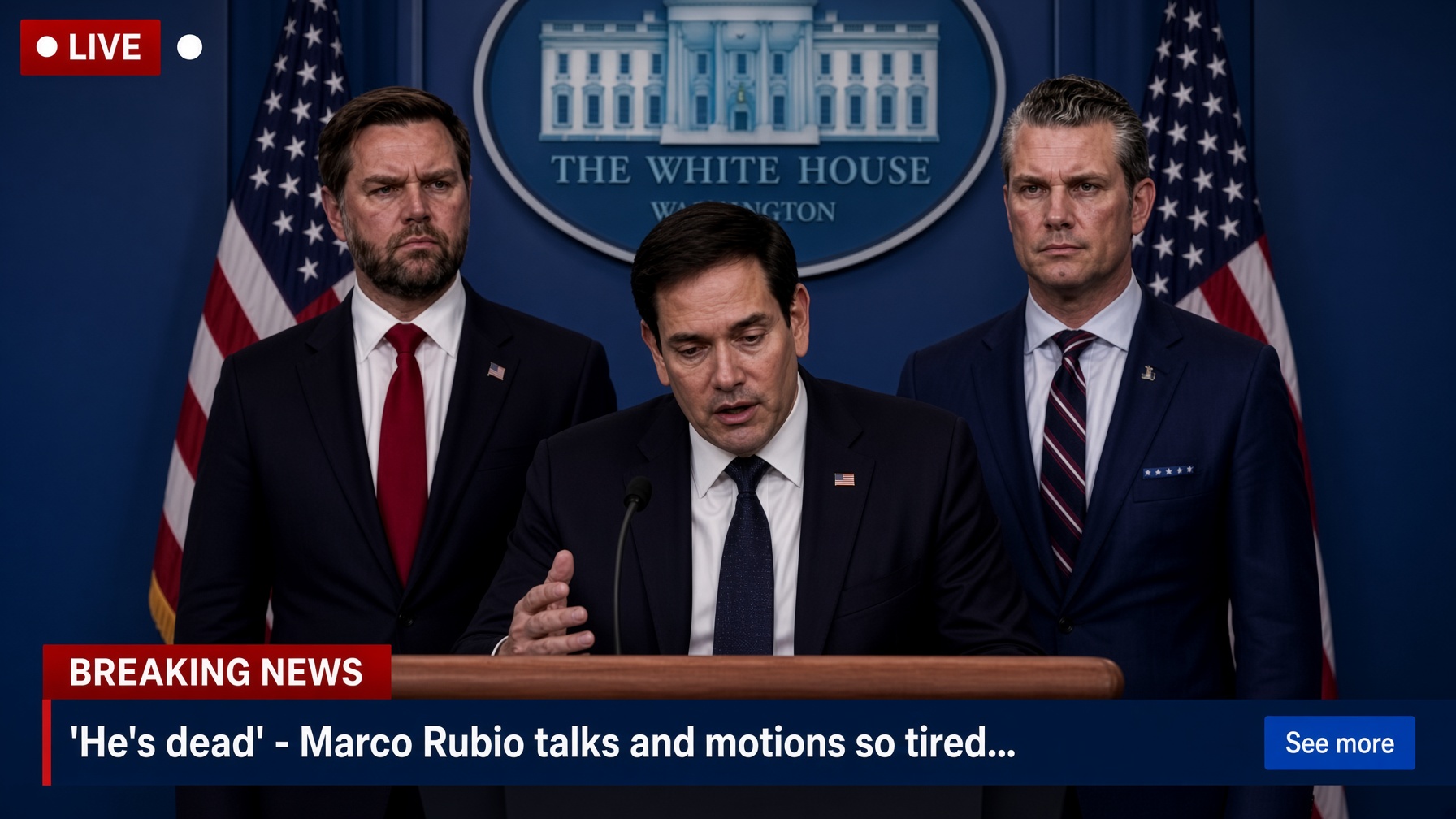
Secretary of State Marco Rubio has recounted an unusual incident aboard Air Force One in which he and other senior officials reportedly spent roughly 90 minutes trying to determine whether a sleeping passenger was simply resting or experiencing a possible medical emergency. Rubio described the episode during an appearance on the Katie Miller Podcast, recalling a tense and awkward situation in which officials were uncertain about whether they should intervene. According to Rubio, the incident occurred while officials were returning from China. At some point during the flight, they noticed a person sleeping inside a conference room aboard the presidential aircraft.
At first, there appeared to be nothing unusual about the situation. Long flights and demanding government schedules can leave passengers exhausted, and sleeping aboard Air Force One is hardly unusual. What concerned Rubio and others, however, was how difficult it appeared to be to get a response from the individual. Rubio said the person seemed unresponsive despite considerable activity and noise taking place nearby.
The situation prompted officials to begin discussing whether someone should wake the passenger or seek medical assistance. That decision proved more complicated than it initially appeared. For approximately an hour and a half, those nearby reportedly wrestled with the uncertainty. If the individual was simply sleeping deeply, waking them unnecessarily could have resulted in an awkward or embarrassing moment. But if the person was actually suffering from a medical problem, waiting too long could have carried much greater consequences.
Officials Concerned About Passenger’s Breathing
Rubio said the concern increased because the individual’s breathing appeared unusual, adding another reason for officials to question whether the situation was merely ordinary sleep. Eventually, the matter was resolved without emergency intervention. “Luckily, the person was fine,” Rubio said. Rubio did not identify the passenger involved, and the account did not provide enough information to establish the person’s identity independently.
The lack of identifying details subsequently led to speculation and jokes on social media, where some users suggested possible names. There is no evidence presented by Rubio, however, to support those online claims. He did not identify the individual, and speculation circulating online should not be treated as confirmation of who was involved.
The anecdote received additional attention because Rubio has previously been questioned publicly about whether he had observed President Donald Trump falling asleep during official meetings. During a House Foreign Affairs Committee hearing, Democratic Rep. Ted Lieu questioned Rubio about whether he had personally witnessed Trump falling asleep. Rubio said he had not.
Rubio Defends Trump’s Attentiveness
Rubio instead described Trump as someone who maintains a demanding schedule and said he had never personally seen the president sleeping during a meeting. Lieu subsequently pointed to video footage that he said showed Trump with his eyes closed during a meeting while Rubio was speaking. Rubio maintained that he had not personally witnessed the president fall asleep.
The Air Force One episode described by Rubio was different in nature. His account did not center on a political dispute or a question about the president’s behavior. Instead, it involved an unusual situation in which government officials were confronted with uncertainty over whether a person who appeared to be deeply asleep might actually need medical attention.
The circumstances also illustrate one of the unusual challenges associated with traveling aboard the presidential aircraft. Air Force One functions not only as a means of transportation but also as a highly secure working environment where senior officials frequently conduct meetings, communicate with government agencies and continue official duties while traveling. In such an environment, an apparently ordinary situation can quickly become a matter requiring careful judgment.
Rare Glimpse Into Air Force One Operations
Rubio’s story ultimately ended without the medical emergency that officials had feared. The individual was reportedly fine, and no emergency intervention was necessary. Still, the episode provided a rare glimpse into the uncertainty that can arise during high-level government travel. What initially looked like an ordinary nap became a prolonged discussion among senior officials because they could not immediately determine whether the person was simply sleeping or potentially in distress.
For roughly 90 minutes, officials faced a basic but consequential question: Should they leave the person alone, wake them, or call for medical assistance? In the end, the concern proved unnecessary. But Rubio’s account underscores how quickly an ordinary moment aboard Air Force One can become an unexpected situation requiring caution, observation and a difficult decision.