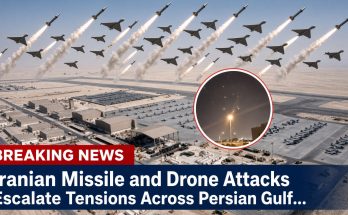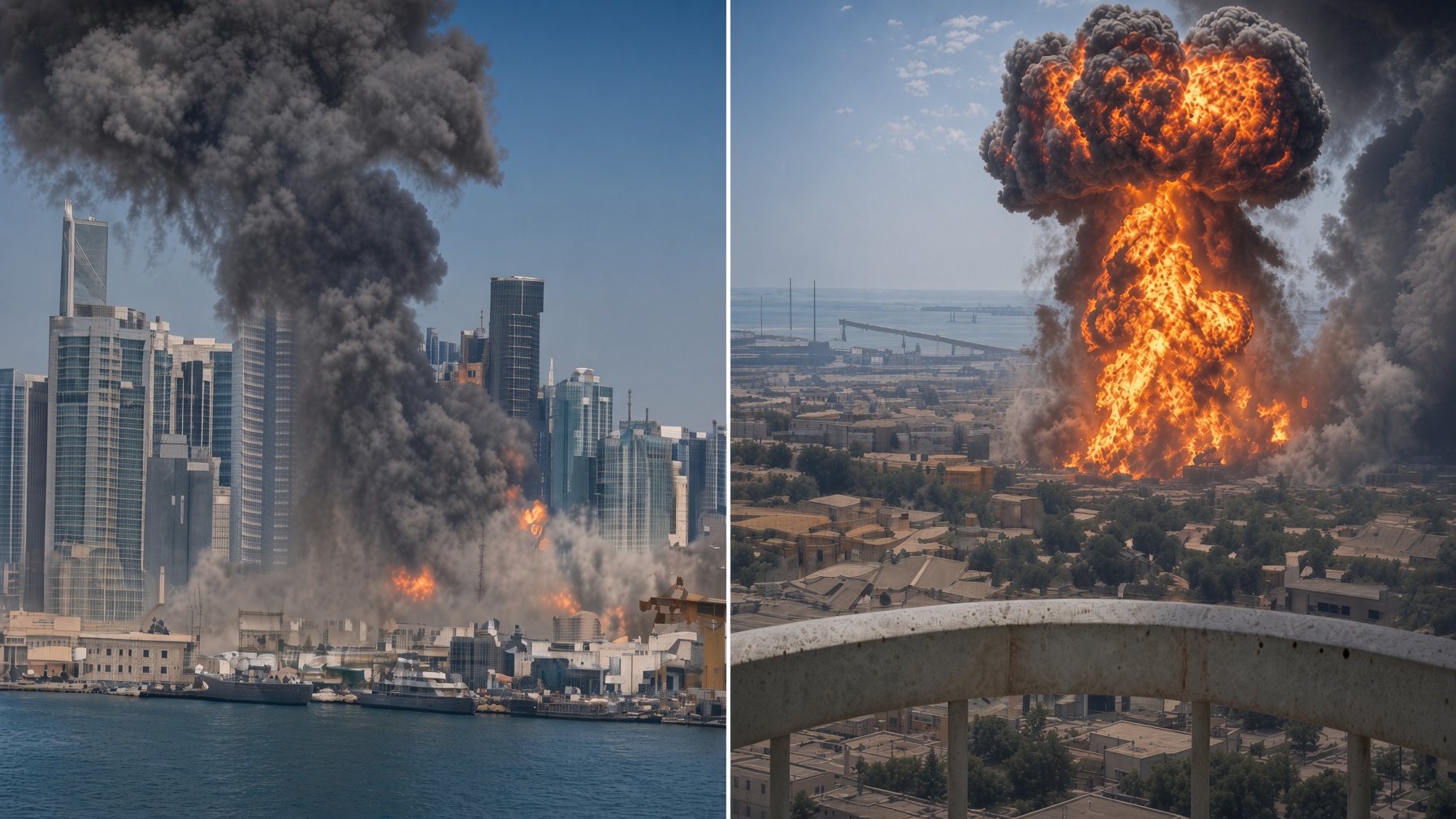
DUBAI — The Persian Gulf has shifted back to an active war footing following successive salvos of Iranian ballistic missiles and one-way attack drones launched at military installations hosting American personnel across the region. The expanding exchanges have forced Gulf Cooperation Council (GCC) states to engage integrated air-defense networks and issue emergency public alerts, intensifying fears that a previously localized confrontation is metastasizing into a broader regional war.
The strikes underscore how rapidly kinetic operations can radiate beyond Iran’s borders to engulf the Arabian Peninsula. The United States maintains an expansive military footprint across Bahrain, Qatar, Kuwait, and the United Arab Emirates. As Tehran has opted to broaden its target set in response to Western pressure and military strikes, these sovereign host nations have found their airspaces and base perimeters transformed into front lines.
In the United Arab Emirates, defense systems were placed on maximum alert following incoming aerial vectors and retaliatory alerts. UAE multi-layered air defenses—which include U.S.-supplied Patriot and Terminal High Altitude Area Defense (THAAD) batteries—have engaged hostile inbound threats during successive waves of fire.
At the focal point of the Emirati theater is Al Dhafra Air Base, situated south of Abu Dhabi. The base functions as a primary hub for the U.S. Air Force’s 380th Air Expeditionary Wing, housing surveillance platforms, advanced multi-role fighter squadrons, and reconnaissance capabilities critical to American command and control.
Iranian operational commanders have repeatedly claimed strikes against logistical nodes and military infrastructure at Al Dhafra. While Iranian state media often broadcasts sweeping claims of operational disruption, Western defense officials and regional monitors have urged scrutiny of unverified battle-damage assessments pending comprehensive structural surveys and satellite verification.
The geographical scope of Tehran’s barrages extends across the Gulf’s northern and central maritime perimeters. In Bahrain, sirens have sounded over the kingdom’s critical security infrastructure. Manama hosts Naval Support Activity Bahrain—the operational headquarters of the U.S. Navy’s Fifth Fleet and the Combined Maritime Forces—making it one of the most strategically sensitive American defense nodes in the world.
Iranian forces have claimed strikes on several Bahraini facilities linked to American logistical support, including Sheikh Isa Air Base. Bahraini defense forces have confirmed engaging aerial threats during recent barrages, operating in close coordination with American naval assets stationed in adjacent waters.
To the northwest, Qatar’s Al Udeid Air Base—the largest American military installation in the Middle East and the forward headquarters for U.S. Central Command (CENTCOM)—has faced recurring threats. Al Udeid serves as the nerve center for regional airspace management and joint air operations. Independent satellite imagery from prior rounds of strikes confirmed focal damage to auxiliary infrastructure, highlighting the persistent threat posed by Tehran’s expansive inventory of precision-guided munitions.
Kuwait has experienced similar exposure. Facilities supporting American logistics and troop staging, including Ali Al Salem Air Base, have been placed on heightened readiness as Kuwaiti and U.S. air-defense teams monitor radar corridors along the northern Gulf.
Beyond the immediate tactical threat to military personnel, the pattern of strikes poses severe systemic risks to global energy security.
The escalations converge directly on the Strait of Hormuz, a maritime chokepoint through which roughly 20 percent of the world’s petroleum consumption passes daily. The persistent threat of aerial debris, littoral missile batteries, and drone swarms has already caused maritime shipping rates to surge and prompted major commercial carriers to alter navigation routes.
International energy markets remain hyper-reactive to Gulf instability. Any sustained disruption to tanker traffic or coastal hydrocarbon processing plants risks triggering severe inflationary shocks across global energy benchmarks, compounding economic vulnerabilities across import-dependent economies.
The strategic trajectory across the Gulf reflects a volatile cycle of offense and response. Washington maintains significant deterrent capability in theater, but host nations face mounting domestic and operational challenges in defending airspace against high-volume, low-cost drone swarms and high-velocity ballistic missiles.
For coalition forces and regional partners, immediate operational priorities remain centered on threat interception, early warning verification, and rapid damage mitigation. Yet with every intercepted volley, the margin for error narrows. A single strike resulting in mass casualties on a Gulf installation or a catastrophic breach of commercial shipping infrastructure could eliminate remaining diplomatic off-ramps, locking Washington and Tehran into an uncontained regional conflagration.